1. Android 4.2.2 Ueucmh2 Jelly Bean Firmware Download
| A version of the Android operating system | |
 | |
| Screenshot Android 4.2 Jelly Bean running on a Nexus four | |
| Programmer | |
|---|---|
| Released to manufacturing | June nine, 2012 (2012-06-09) |
| Latest release | 4.3.1_r2 (JLS36I)[one] / November xiv, 2013 (2013-11-14) [2] |
| Kernel blazon | Monolithic Kernel (Linux Kernel) |
| Preceded by | Android iv.0.four "Ice Cream Sandwich" |
| Succeeded by | Android 4.iv "KitKat" |
| Official website | www |
| Support status | |
| Unsupported | |
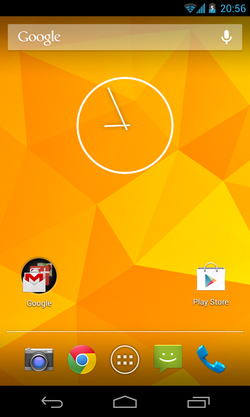
Android Jelly Edible bean is the codename given to the tenth version of the Android mobile operating system adult by Google, spanning three major point releases (versions 4.1 through 4.3.1). Among the devices that run Android 4.3 are the Asus Nexus vii (2013) and the LG Nexus iv.
The first of these three releases, 4.1, was unveiled at Google'southward I/O programmer conference in June 2012. It focused on operation improvements designed to give the operating system a smoother and more than responsive feel, improvements to the notification system allowing for expandable notifications with activity buttons, and other internal changes. Ii more releases were fabricated under the Jelly Bean proper name in October 2012 and July 2013 respectively, including iv.two—which included further optimizations, multi-user support for tablets, lock screen widgets, quick settings, and screen savers, and four.three—which independent further improvements and updates to the underlying Android platform.
Jelly Bean versions are not receiving updates by Google Play Services. As of July 2021[update], 0.46% of Android devices run Jelly Bean.[3]
Development [edit]
Android 4.1 Jelly Edible bean was first unveiled at the Google I/O developer conference on June 27, 2012, with a focus on "delightful" improvements to the platform's user interface, along with improvements to Google's search experience on the platform (such as Knowledge Graph integration, and the so-new digital assistant Google At present), the unveiling of the Asus-produced Nexus vii tablet, and the unveiling of the Nexus Q media histrion.[4]
For Jelly Bean, work was made on optimizing the operating system's visual functioning and responsiveness through a series of changes referred to as "Project Butter": graphical output is now triple buffered, vsync is used across all drawing operations, and the CPU is brought to total power when touch input is detected—preventing the lag associated with inputs made while the processor is in a low-power state. These changes allow the operating organization to run at a total 60 frames per second on capable hardware.[4] [5] [6]
Following 4.1, two more Android releases were fabricated under the Jelly Bean codename; both of these releases focused primarily on functioning improvements and changes to the Android platform itself, and contained relatively few user-facing changes. Alongside Android iv.1, Google also began to decouple APIs for its services on Android into a new system-level component known as Google Play Services, serviced through Google Play Store. This allows the add-on of certain forms of functionality without having to distribute an upgrade to the operating system itself, addressing the infamous "fragmentation" problems experienced by the Android ecosystem.[7]
Release [edit]
Attendees of the Google I/O briefing were given Nexus 7 tablets pre-loaded with Android 4.1, and Galaxy Nexus smartphones which could exist upgraded to 4.1. Google announced an intent to release 4.1 updates for existing Nexus devices and the Motorola Xoom tablet past mid-July.[viii] The Android 4.i upgrade was released to the general public for GSM Galaxy Nexus models on July 10, 2012.[iv] [nine] [x] In late 2012, post-obit the official release of Jelly Bean, a number of third-party Android OEMs began to fix and distribute updates to four.1 for their existing smartphones and tablets, including devices from Acer, HTC, LG, Motorola, Samsung, Sony, and Toshiba.[xi] In August 2012, nightly builds of the aftermarket firmware CyanogenMod based on iv.1 (branded as CyanogenMod 10) began to be released for selected devices, including some Nexus devices (the Nexus S and Galaxy Nexus), the Samsung Galaxy Southward, Galaxy Due south 2, Galaxy Tab two 7.0, Motorola Xoom, and Asus Transformer.[12]
On October 29, 2012, Google unveiled Android 4.2, dubbed "a sweeter tasting Jelly Bean", alongside its accompanying launch devices, the Nexus 4 and Nexus 10. Firmware updates for the Nexus seven and Galaxy Nexus were released in November 2012.[thirteen] [14] [15] Android iv.iii was subsequently released on July 24, 2013 via firmware updates to the Galaxy Nexus, 2012 Nexus vii, Nexus 4, and Nexus 10.[16]
Features [edit]
User experience [edit]
Visually, Jelly Bean's interface reflects a refinement of the Holo advent introduced past Android 4.0.[17] The default dwelling house screen of Jelly Edible bean received new features, such every bit the power for other shortcuts and widgets on a habitation screen page to re-suit themselves to fit an item existence moved or resized. The notification system was also improved with the addition of expandable and actionable notifications; private notifications can at present display additional content or action buttons (such equally Call back or Bulletin on a missed call), accessible by dragging open the notification with a two-finger gesture. Notifications can besides be disabled individually per app.[18]
Android four.ii added additional features to the user interface; the lock screen tin can exist swiped to the left to brandish widget pages, and swiped to the correct to go to the photographic camera. A pane of quick settings toggles (a feature ofttimes seen in OEM Android skins) was also added to the notification area— attainable by either swiping down with two fingers on phones, swiping downwardly from the summit-right border of the screen on tablets, or pressing a button on the peak-right corner of the notifications pane. The previous Browser application was officially deprecated on four.2 in favor of Google Chrome for Android. 4.2 also adds gesture typing on the keyboard, a redesigned Clock app, and a new screensaver arrangement known as Daydreams. On tablets, Android 4.ii also supports multiple users.[5] [14] [17]
To promote consistency between device classes, Android tablets at present use an expanded version of the interface layout and home screen used by phones by default, with centered navigation keys and a status bar across the top. These changes took outcome for small tablets (such as the Nexus 7) on iv.i, and for larger tablets on four.2. Modest tablets on Android are optimized primarily for use in a portrait (vertical) orientation, giving apps expanded versions of the layouts used past phones. When used in a "landscape" (horizontal) orientation, apps suit themselves into the widescreen-oriented layouts seen on larger tablets. On large tablets, navigation buttons were previously placed in the bottom-left of a bar along the bottom of the screen, with the clock and notification surface area in the bottom-correct.[xix] [xx] [21]
Platform [edit]
For developers, 4.1 also added new accessibility APIs, expanded language back up with bi-directional text back up and user-supplied keymaps, support for managing external input devices (such as video game controllers), back up for multichannel, USB, and gapless sound, a new media routing API, depression-level access to hardware and software audio and video codecs, and DNS-based service discovery and pre-associated service discovery for Wi-Fi. Android Beam can now also be used to initiate Bluetooth file transfers through near-field advice.[21]
Android four.two added a rewritten Bluetooth stack, changing from the previous Bluez stack (GPL created past Qualcomm) to a rewritten Broadcom open up source stack chosen BlueDroid.[22] [23] The new stack, initially considered "immature",[24] promised several forrad-looking benefits,[22] including improved support for multiple displays, support for Miracast, native right-to-left support, updated developer tools, farther accessibility improvements such equally zooming gestures, and a number of internal security improvements such as always-on VPN back up and app verification.[21] A new NFC stack was added at the same time.[22]
Android 4.three consisted of further low-level changes, including Bluetooth low energy and AVRCP back up, SELinux, OpenGL ES 3.0, new digital rights direction (DRM) APIs, the ability for apps to read notifications, a VP8 encoder, and other improvements.[16]
Android 4.3 too included a subconscious privacy feature known as "App Ops", which allowed users to individually deny permissions to apps. However, the feature was after removed on Android four.4.2; a Google spokesperson stated that the characteristic was experimental and could preclude certain apps from performance correctly if used in sure ways.[25] [26] The concept was revisited as the basis of a redesigned permissions system for Android 6.0.[27]
Come across also [edit]
- Android version history
- Firefox Bone
- iOS half-dozen
- Windows Phone 7
- Windows vii
References [edit]
- ^ "Android Source". Google Git.
- ^ http://www.phonearena.com/news/Android-4.3.ane-update-surprises-Nexus-vii-2013-owners-rolling-out-now_id47971
- ^ "Mobile & Tablet Android Version Market Share Worldwide - September 2020". StatCounter Global Stats . Retrieved September 22, 2019.
- ^ a b c "Android 4.1 Jelly Bean: faster, smoother, more delightful". Ars Technica . Retrieved July ii, 2014.
- ^ a b Bookwalter, J.R. (July 10, 2012). "Android 4.ane: Jelly Bean review". TechRadar. Future Publishing. Retrieved September 1, 2012.
- ^ Fingas, Jon (June 27, 2012). "Project Butter improves Android 4.i'south speed to a silky-smoothen 60FPS". Engadget. AOL. Archived from the original on June 29, 2012. Retrieved August 15, 2012.
- ^ "Averse carriers and boring OEMs step aside: Google is defragging Android". Ars Technica . Retrieved September 3, 2013.
- ^ "Google announces Android four.1 Jelly Bean, with Project Butter visuals and new Search, mid-July". The Side by side Web. Retrieved June 28, 2012.
- ^ "Android iv.1 (Jelly Bean) now hit all Galaxy Nexus HSPA+ devices". Engadget. AOL. Retrieved July 2, 2014.
- ^ "Android four.1 OTA update available for manual download for a few Milky way Nexus devices". The Verge . Retrieved July 2, 2014.
- ^ Raphael, JR. "Android four.ane upgrade list: Is your device getting Jelly Edible bean?". Computerworld. Archived from the original on Apr 30, 2013. Retrieved July 3, 2014.
- ^ "CM10 nightly builds now rolling out to select devices". Engadget . Retrieved July 25, 2014.
- ^ Topolsky, Joshua (Oct 19, 2012). "The Nexus 4: Google's flagship phone lands November 13th for $299". The Verge . Retrieved January 26, 2013.
- ^ a b Ion, Florence (November 7, 2012). "Review: Android 4.2 is a sweeter-tasting Jelly Bean". Ars Technica . Retrieved Dec i, 2012.
- ^ "Android iv.2 for Galaxy Nexus and Nexus 7 available to download at present (update)". The Verge . Retrieved July 2, 2014.
- ^ a b "Android 4.3 Jelly Bean official: aircraft with new Nexus seven, available OTA for select devices today". Engadget . Retrieved November ii, 2013.
- ^ a b Amadeo, Ron (June 16, 2014). "The history of Android: The endless iterations of Google's mobile Os". Ars Technica. Condé Nast. Retrieved July 6, 2014.
- ^ "Android 4.ane Jelly Bean coming in July with Projection Butter UI, Google At present, richer notifications". The Verge . Retrieved July two, 2014.
- ^ "Confirmed: Android 4.1 uses different layouts for dissimilar tablet sizes". ComputerWorld. Archived from the original on January 19, 2013. Retrieved July 8, 2012.
- ^ "Nexus seven gets homescreen rotation with Android four.1.2 update". CNET. CBS Interactive. Retrieved July two, 2014.
- ^ a b c "Jelly Bean". Android developer portal . Retrieved July two, 2014.
- ^ a b c Brian Klug. "The Side by side Version of Android - Some of What's Coming". anandtech.com.
- ^ "FOSS Patents". fosspatents.com.
- ^ "Archived copy". Archived from the original on September 27, 2014. Retrieved September 29, 2014.
{{cite web}}: CS1 maint: archived re-create as title (link) - post by Stanislav Shalunov, CTO of Open Garden - ^ "KitKat update removes app permissions toggle". CNET . Retrieved Baronial 31, 2014.
- ^ "Why Android won't be getting App Ops anytime soon". CNET . Retrieved August 31, 2014.
- ^ Chester, Brandon (May 28, 2015). "Google Announces Android M At Google I/O 2015". AnandTech. Purch Group. Retrieved March half dozen, 2017.
External links [edit]
DOWNLOAD HERE
Posted by: thibodeauforgageds.blogspot.com